Official text · Form N 2
Road markings
This translation is unofficial. The Armenian text is the legally binding version.
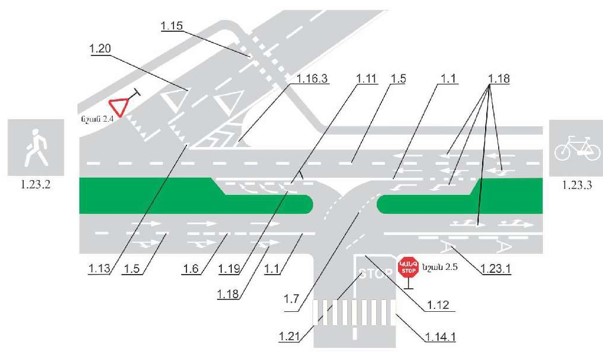
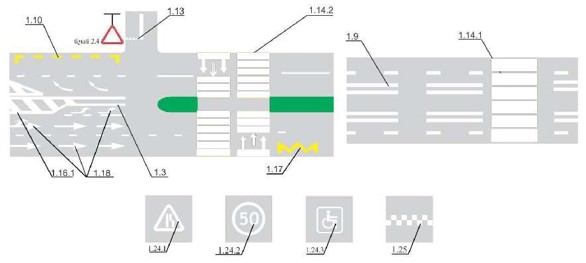
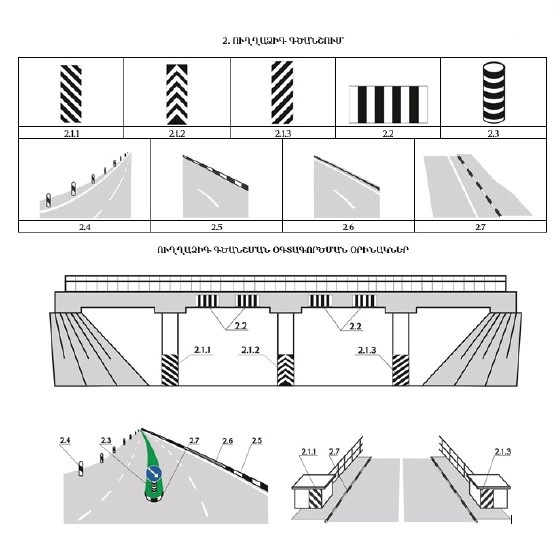
Explore the illustrated road markings category on the Road signs page.
Open road markingsHorizontal markings
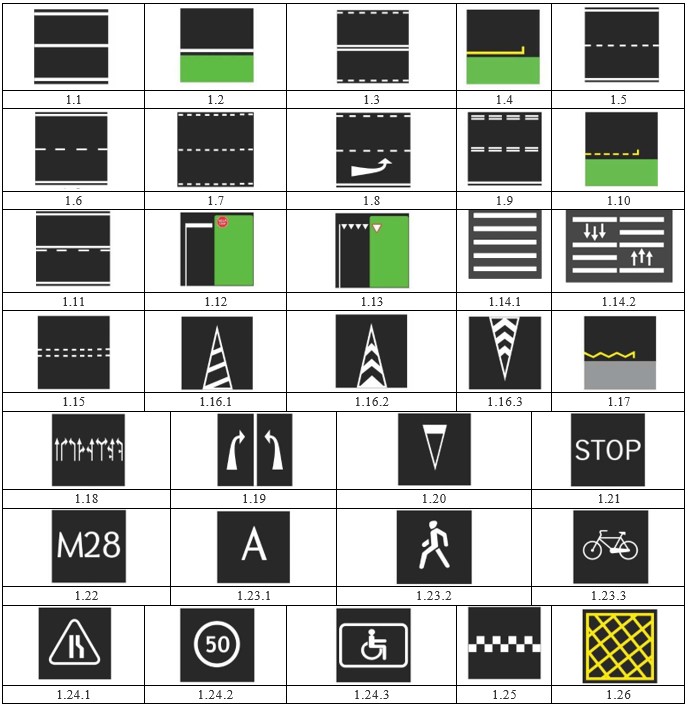
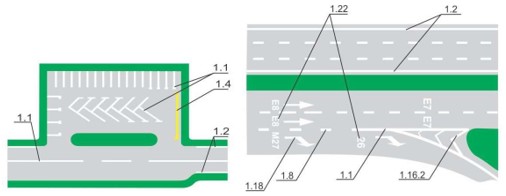
a solid line that separates traffic flows in opposite directions (centre line), marks the boundaries of lanes at dangerous places on the road, marks the edges of the carriageway where entry is prohibited, and marks the boundaries of parking spaces;
6 questionsa solid line (edge line) that marks the edge of the carriageway and of the central reservation;
2 questionson roads with four or more lanes, separates traffic flows in opposite directions (centre lines);
5 questionsa solid yellow line that marks places where stopping and parking are prohibited. It is used on its own or with sign 3.27 “No stopping” and is painted at the edge of the carriageway (instead of the edge line, if there is one) or on top of the kerb;
11 questionsa broken line that separates traffic flows in opposite directions on roads with two or three lanes (centre line), and marks lane boundaries on roads with two or more lanes in one direction;
4 questions“approach line” — a broken line warning of an approaching 1.1 or 1.11 marking that separates traffic flows in opposite or the same directions (each dash is three times as long as the gap between dashes);
2 questionsa broken line marking lanes within an intersection (dashes and gaps are of equal length);
3 questionsa wide broken line marking the boundary between the main carriageway and an acceleration or deceleration lane;
2 questionsa broken (reversible) line marking the boundaries of lanes with reversible traffic control; when the reversible traffic lights are off, it separates traffic flows in opposite directions;
8 questionsa broken yellow line that marks places where parking is prohibited. It is used on its own or with sign 3.28 “No parking” and is painted at the edge of the carriageway (instead of the edge line, if there is one) or on top of the kerb;
8 questionsseparates traffic flows in opposite or the same directions on sections of road where changing lanes is permitted from one lane only;
marks places for U-turns and for entering and leaving adjacent areas, and similar places, where movement is permitted in one direction only;
2 questions“Stop line” — a solid line showing where the driver must stop when there is a prohibiting signal of a traffic light (controller) or sign 2.5 “Stop”, and before a level crossing when crossing is prohibited;
10 questionsshows where the driver must stop, if necessary, and give way to vehicles on the intersecting road;
8 questions“Zebra” — marks a pedestrian crossing. The arrows of marking 1.14.2 show the direction in which pedestrians move;
where traffic flows in opposite directions separate,
where traffic flows in the same direction separate,
where traffic flows from different directions merge;
a solid yellow zigzag line that marks public transport stops and, where sign 5.18 “Taxi rank” is installed, taxi ranks;
4 questionsshows the permitted directions of travel at an intersection by lane. It is used on its own or with signs 5.15.1 “Lane directions” and 5.15.2 “Lane direction”. A marking showing a dead end means that turning onto the nearest carriageway is prohibited. A marking permitting a left turn from the leftmost lane also permits a U-turn;
20 questionswarns of an approaching:
end of a lane (a section where the number of lanes in that direction decreases). It may be used with signs 1.20.1–1.20.3 “Road narrows”;
4 questionsmarking 1.1 or 1.11 separating traffic flows in opposite directions. It is used together with marking 1.6 “Approach line”;
the inscription “STOP” — warns of an approaching 1.12 marking when it is used with sign 2.5 “Stop”;
2 questionsduplicate road signs 1.20.2 “Road narrows”, 3.24 “Maximum speed limit” and 8.17 “Disabled people” respectively, and are used together with them;
2 questionsduplicates plate 8.4.3.1; used on its own or together with plate 8.4.3.1;
(yellow) marks a section of an intersection that must not be entered if there is a traffic jam ahead in the direction of travel that would force the driver to stop and block vehicles moving across on the intersecting road, except when turning right or left as provided for in these Rules. It is used on its own or with sign 1.35 “Intersection area”.
4 questionsLines 1.1, 1.2 and 1.3 must not be crossed.
9 questionsLine 1.1 may be crossed where it marks the boundaries of parking spaces, when manoeuvring to enter or leave a parking space; line 1.2 may be crossed to stop on the verge and to move off from it, in places where stopping or parking is permitted.
12 questionsLines 1.5–1.8 may be crossed from either side.
When there are no reversible traffic lights or they are switched off, marking 1.9 may be crossed if it is on the driver’s right; when the reversible traffic lights are on, it may be crossed from either side if the lines separate lanes for traffic in the same direction. When the reversible traffic lights are switched off, the driver must immediately move to the right of marking 1.9.
2 questionsWhen the reversible traffic lights are switched off, marking 1.9 separating traffic flows in opposite directions must not be crossed.
5 questionsLine 1.11 may be crossed from the side of the broken line, and also from the side of the solid line when completing overtaking or going around an obstacle.
14 questionsVertical markings
Mark:
elements of road structures (bridge and overpass supports, the ends of parapets, etc.) where they pose a danger to moving vehicles;
2 questionsround bollards on central reservations and traffic islands;
guide posts, delineators, barrier posts, etc.;
the side surfaces of road barriers on small-radius bends, steep descents and other dangerous sections;
2 questionsthe side surfaces of road barriers on other sections;
kerbs and raised traffic islands on dangerous sections.