
Official text · Chapter II
Traffic light and traffic controller signals
This translation is unofficial. The Armenian text is the legally binding version.
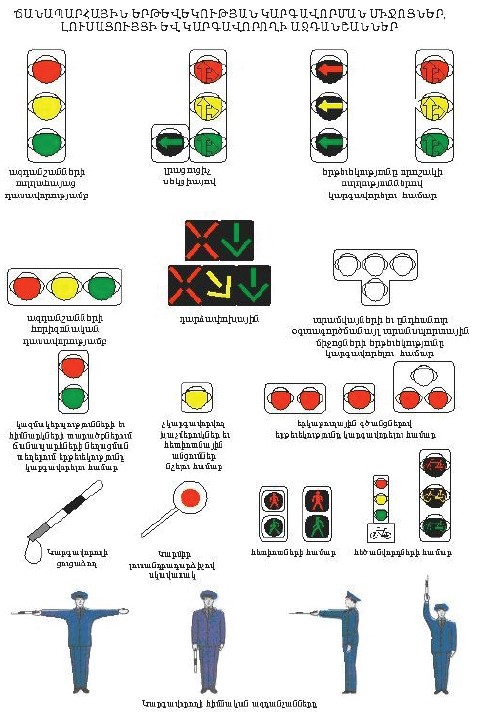
Traffic lights use green, yellow, red and white-lunar light signals.
Depending on their purpose, traffic lights regulate the movement of vehicles, pedestrians or cyclists. Their signals are round (without a symbol), or show a symbol — an arrow (arrows), the silhouette of a pedestrian or a bicycle — or are X-shaped.
Traffic lights with round signals may have one or two additional sections with green arrow signals, mounted at the level of the green signal.
Round traffic light signals mean the following:
a green signal permits movement (countdown displays may be used to inform drivers and pedestrians of the time, in seconds, remaining until the end of the green signal);
7 questionsa flashing green signal permits movement and informs that its time is running out and a prohibiting signal will soon come on;
2 questionsa yellow signal prohibits movement (except in the case provided for in clause 19 of the Rules) and warns of an upcoming change of signal;
a flashing yellow signal permits movement and indicates an unregulated intersection or pedestrian crossing, and also warns of a hazard;
6 questionsa red signal, including a flashing red, prohibits movement (countdown displays may be used to inform drivers and pedestrians of the time, in seconds, remaining until the end of the red signal);
1 questionsred and yellow signals together prohibit movement and indicate that the green signal is about to come on.
4 questionsRed, yellow and green arrow signals have the same meaning as round signals of the corresponding colour, but apply only to the direction(s) shown by the arrows. An arrow permitting a left turn also permits a U-turn unless this is prohibited by a road sign. A green arrow in an additional section has the same meaning. When the signal of an additional section is off, movement in the direction regulated by that section is prohibited.
17 questionsInstead of red and yellow arrows, round red and yellow signals with black outline arrows may be used; they have the same meaning.
A black outline arrow (arrows) on the main green signal informs drivers that there is an additional section and shows permitted directions other than those covered by the additional section’s signal.
4 questionsSignals in the form of a bicycle silhouette regulate cyclists, and signals in the form of a pedestrian silhouette regulate pedestrians. Flashing white-lunar (yellowish) information sections showing a person and an arrow may be installed below a vehicle traffic light to warn drivers that pedestrians are on the crossing. A traffic light with smaller round signals, together with a plate showing a bicycle, may also be used to regulate cyclists.
In places where blind pedestrians frequently appear on the road, the green signal may be accompanied by an audible signal, distinct from vehicle (special) audible signals, informing them that they may cross the carriageway.
1 questionsTo regulate traffic in individual lanes of the carriageway — in particular, lanes where the direction of traffic can be reversed — reversible traffic lights are used, with a red X-shaped signal and a green signal in the form of a downward arrow, which respectively prohibit or permit traffic in the lane above which they are mounted. The main signals of reversible traffic lights may be supplemented with a yellow signal in the form of an arrow pointing diagonally down to the right or left; when it comes on, it indicates that the signal is about to change and that drivers must move into the lane indicated by the arrow. If the signals of a reversible traffic light above a lane marked on both sides with marking 1.9 are off, entering that lane is prohibited.
16 questionsTo regulate trams and other public transport vehicles travelling in a dedicated lane, traffic lights with four round white-lunar signals arranged in a T shape may be used. Movement is permitted only when the bottom signal is on together with one or more of the upper signals: the left one permits movement to the left, the middle one straight ahead and the right one to the right. If one or more upper signals are on without the bottom signal, movement is prohibited.
15 questionsAt a level crossing, a flashing round white-lunar signal permits vehicles to cross, and a red signal prohibits it. If both the flashing white-lunar and the red signals are off, crossing is permitted if no train (locomotive, rail trolley) is approaching within sight.
2 questionsarm raised upwards — vehicles and pedestrians must not move, except in the cases provided for in clause 19 of the Rules;
from the left and right sides, non-rail vehicles may go straight ahead and turn right, trams may go straight ahead; pedestrians may cross the carriageway on the controller’s right and left sides,
18 questionsfrom the left side, non-rail vehicles may move in all directions, trams may turn left,
17 questionsfrom the back and right side, all vehicles must not move,
pedestrians may cross the carriageway behind the controller’s back.
To make the signals clearly visible, the controller may use a baton, including one with a red signal or a reflector disc, and may also blow a whistle to attract road users’ attention. The controller may also give other hand signals that drivers and pedestrians can understand.
3 questionsWhen a traffic light (other than a reversible one) or a controller shows a prohibiting signal, the driver must stop before the “Stop line” marking (or sign 6.16 “Stop line”), and if there is none:
4 questionsbefore the carriageway being crossed, taking clause 93 of the Rules into account and without impeding pedestrians;
before a level crossing, in accordance with clause 111 of the Rules;
elsewhere — before the traffic light or the controller, without impeding vehicles and pedestrians moving in permitted directions.
2 questionsWhen the yellow signal comes on or the controller raises an arm, drivers who cannot stop at the places specified in clause 18 of the Rules without sharp braking may continue. On this signal, pedestrians on the carriageway must clear it, and if that is not possible, stop on the line dividing opposing traffic flows.
2 questionsDrivers and pedestrians must obey the instructions and signals of the traffic controller even if they contradict traffic light signals or the requirements of road signs or markings.
10 questionsAt level crossings, an audible signal may be given together with the flashing red traffic light to additionally inform road users that crossing is prohibited.